


Similar Posts
BIDS Managing and Analysis Tool
> Github repository
The BMAT software is a complete and easy-to-use local open-source neuroimaging analysis tool with a graphical user interface (GUI) that uses the BIDS format to organize and process brain MRI data for MS imaging research studies. BMAT provides the possibility to translate data from MRI scanners to the BIDS structure, create and manage BIDS datasets as well as develop and run automated processing pipelines.BMAT is now compatible to work with remote server using shared samba folder and a slurm scheduler to process data on remote server. It has to be noted that this feature has been implemented for users based in the Institute of NeuroSciences (IoNS) from UCLouvain. Therefore, it may not work easily with every servers, but feel free to fork the code and adapt it for your institue.
- Gratuit | MedToolBox | Neuro | Non certifié | Tier 2
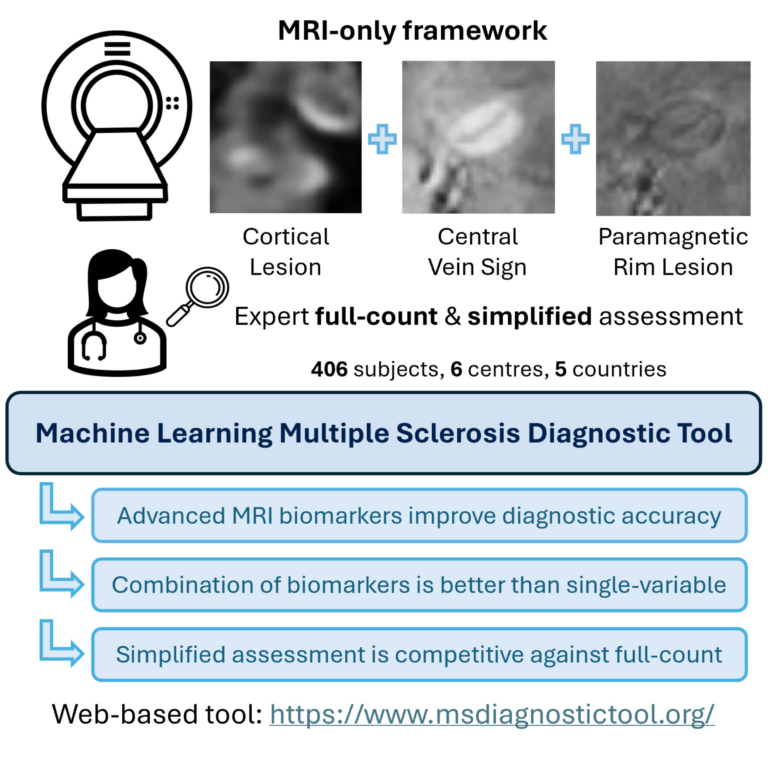
Multiple Sclerosis Diagnostic Tool
Multiple sclerosis diagnostic criteria lack optimal specificity, leading to potential misdiagnosis. Advanced magnetic resonance imaging (MRI) biomarkers like the central vein sign, cortical lesions, and paramagnetic rim lesions are highly specific to multiple sclerosis and could potentially improve diagnostic accuracy. In this study, we applied machine learning techniques to a retrospective, multicentric dataset of 322…
TEF-Health
Testing and Experimentation Validation Evaluation Facilities for health ai and robotics
LiblineaR
LiblineaR is an R package for large-scale linear modeling supporting classification and regression of large datasets. The original software in C/C++ was developed by Prof. Chih-Jen Lin and his team at the Machine Learning Group of the Taiwan University. As most of our developments are done in the open source R language, we have developed the R library LiblineaR, making all the…
UNRAVEL – Utilizing tractography to uncover multi-fixel microstructure
> Github repository
This repository contains the code used to combine macroscopic tractography information with microscopic multi-fixel model estimates in order to improve the accuracy in the estimation of the microstructural properties of neural fibers in a specified tract.Hercule
The use of data sciences in biomanufacturing routine operations and process improvement can help companies improve their bottom line and remain competitive in a dynamic market, with positive impact on sustainability. Hercule is a technology platform composed of a software suite and a set of services, successfully applied on more than 25 processes so far. Hercule software is composed of a series of modules, for biomanufacturing data structuring, day-to-day…