TEF-Health
Testing and Experimentation Validation Evaluation Facilities for health ai and robotics




Testing and Experimentation Validation Evaluation Facilities for health ai and robotics

For better Healthcare, Research & Policy Making
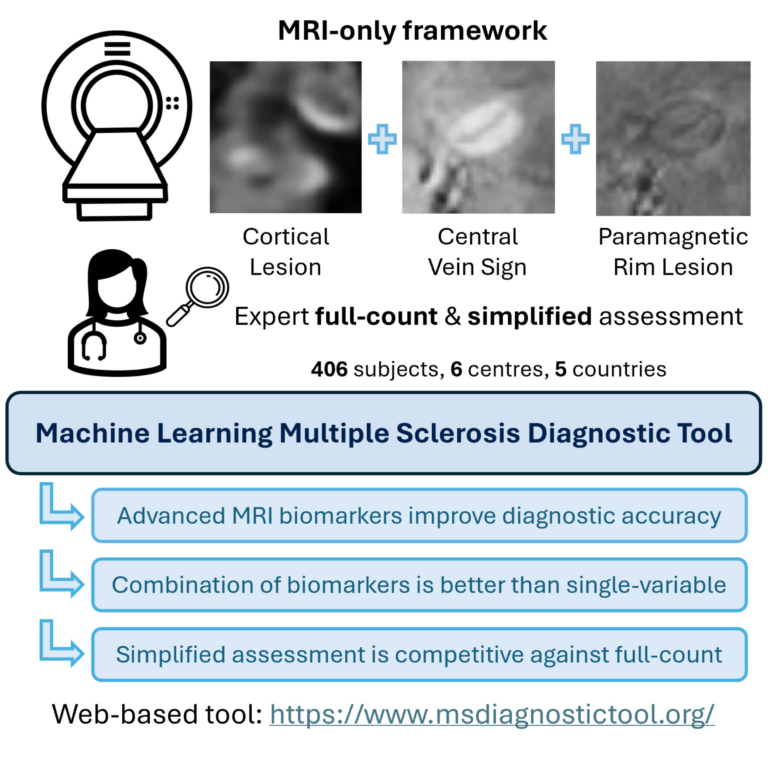
Multiple sclerosis diagnostic criteria lack optimal specificity, leading to potential misdiagnosis. Advanced magnetic resonance imaging (MRI) biomarkers like the central vein sign, cortical lesions, and paramagnetic rim lesions are highly specific to multiple sclerosis and could potentially improve diagnostic accuracy. In this study, we applied machine learning techniques to a retrospective, multicentric dataset of 322…
> Github repository
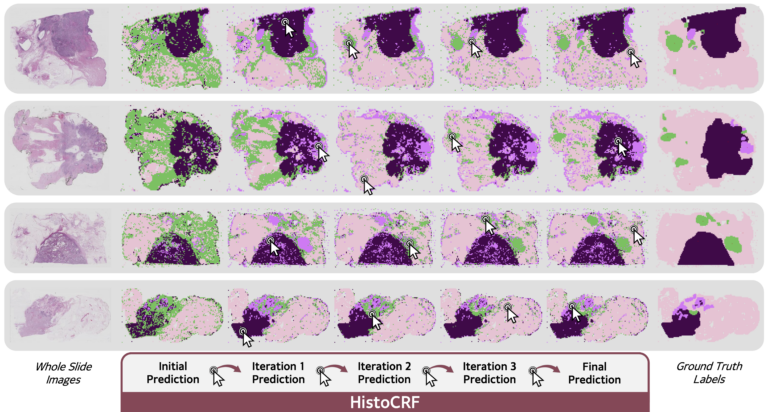
Assisting pathologists in the analysis of histopathological images has high clinical value, as it supports cancer detection and staging. In this context, histology foundation models have recently emerged. Among them, Vision-Language Models (VLMs) provide strong yet imperfect zero-shot predictions. We propose to refine these predictions by adapting Conditional Random Fields (CRFs) to histopathological applications, requiring no additional model training.

> Github repository
This repository contains the code used to combine macroscopic tractography information with microscopic multi-fixel model estimates in order to improve the accuracy in the estimation of the microstructural properties of neural fibers in a specified tract.
> Github repository
The BMAT software is a complete and easy-to-use local open-source neuroimaging analysis tool with a graphical user interface (GUI) that uses the BIDS format to organize and process brain MRI data for MS imaging research studies. BMAT provides the possibility to translate data from MRI scanners to the BIDS structure, create and manage BIDS datasets as well as develop and run automated processing pipelines.
BMAT is now compatible to work with remote server using shared samba folder and a slurm scheduler to process data on remote server. It has to be noted that this feature has been implemented for users based in the Institute of NeuroSciences (IoNS) from UCLouvain. Therefore, it may not work easily with every servers, but feel free to fork the code and adapt it for your institue.
> Github repository
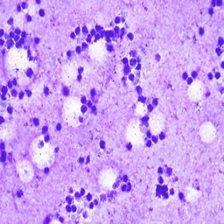
In this paper, we explore the application of existing foundation models to cytological classification tasks, focusing on low-rank adaptation (LoRA), a parameter-efficient fine-tuning method well-suited to few-shot learning scenarios. We evaluate five foundation models across four cytological classification datasets. Our results demonstrate that fine-tuning the pre-trained backbones with LoRA significantly enhances model performance compared to merely fine-tuning the classifier head, achieving state-of-the-art results on both simple and complex classification tasks while requiring fewer data samples.
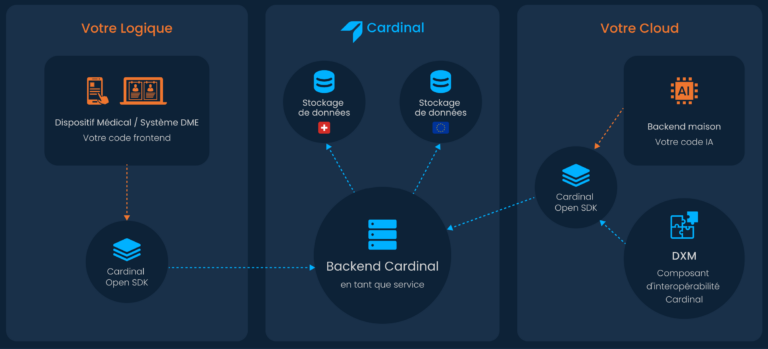
Cardinal est le backend sécurisé de référence pour la Health-Tech. Que vous conceviez des dispositifs médicaux, des dossiers médicaux et patients (DMI-DPI), ou des applications patient-médecin, le Backend et les SDKs Cardinal offrent les outils et le support pour concrétiser votre vision, réduire vos coûts de développement et accélérer votre mise sur le marché. Chaque fonctionnalité disponible dans Cardinal se concentre sur…
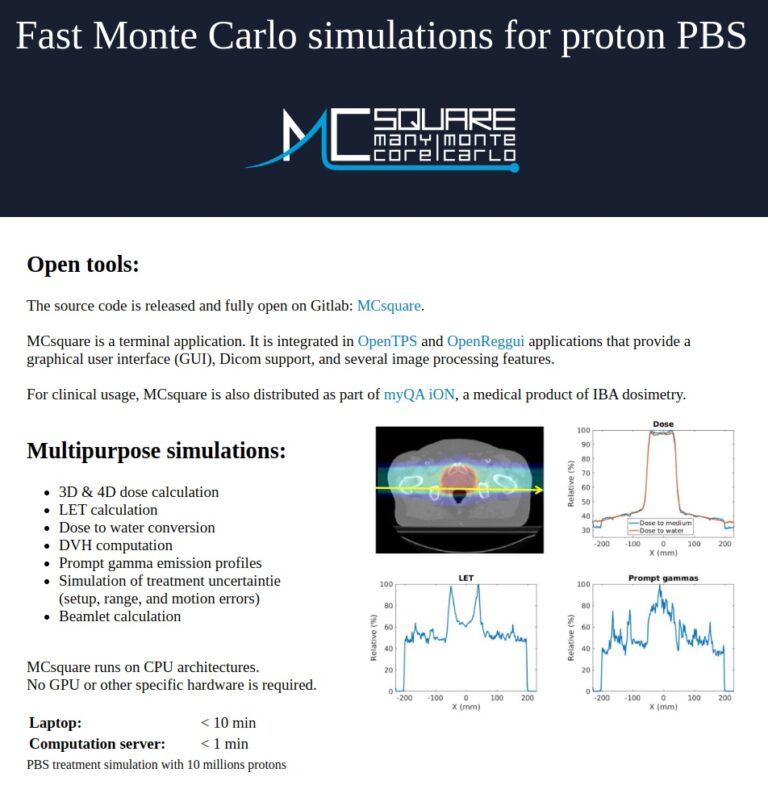
The use of Monte Carlo dose calculation instead of typical analytical algorithms can improve the accuracy of proton therapy treatment planning. Especially, range uncertainties are significantly reduced in heterogeneous anatomies. MCsquare, a new fast Monte Carlo code, has been developed to simulate proton PBS treatments with the accuracy and calculation speed required in the clinic….
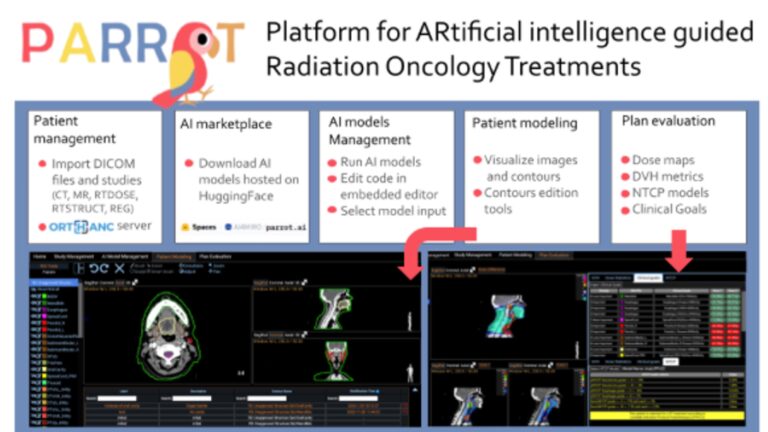
PARROT, which stands for Platform for ARtificial intelligence guided Radiation Oncology Treatment, is a user-friendly, free, and open-source web platform. It allows users to visualize DICOM files, run AI models, display and evaluate predictions easily. The platform includes several trained state-of-the-art dose prediction and contour segmentation models. Users can also add their own models using…