

| | | |

Multiple Sclerosis Diagnostic Tool

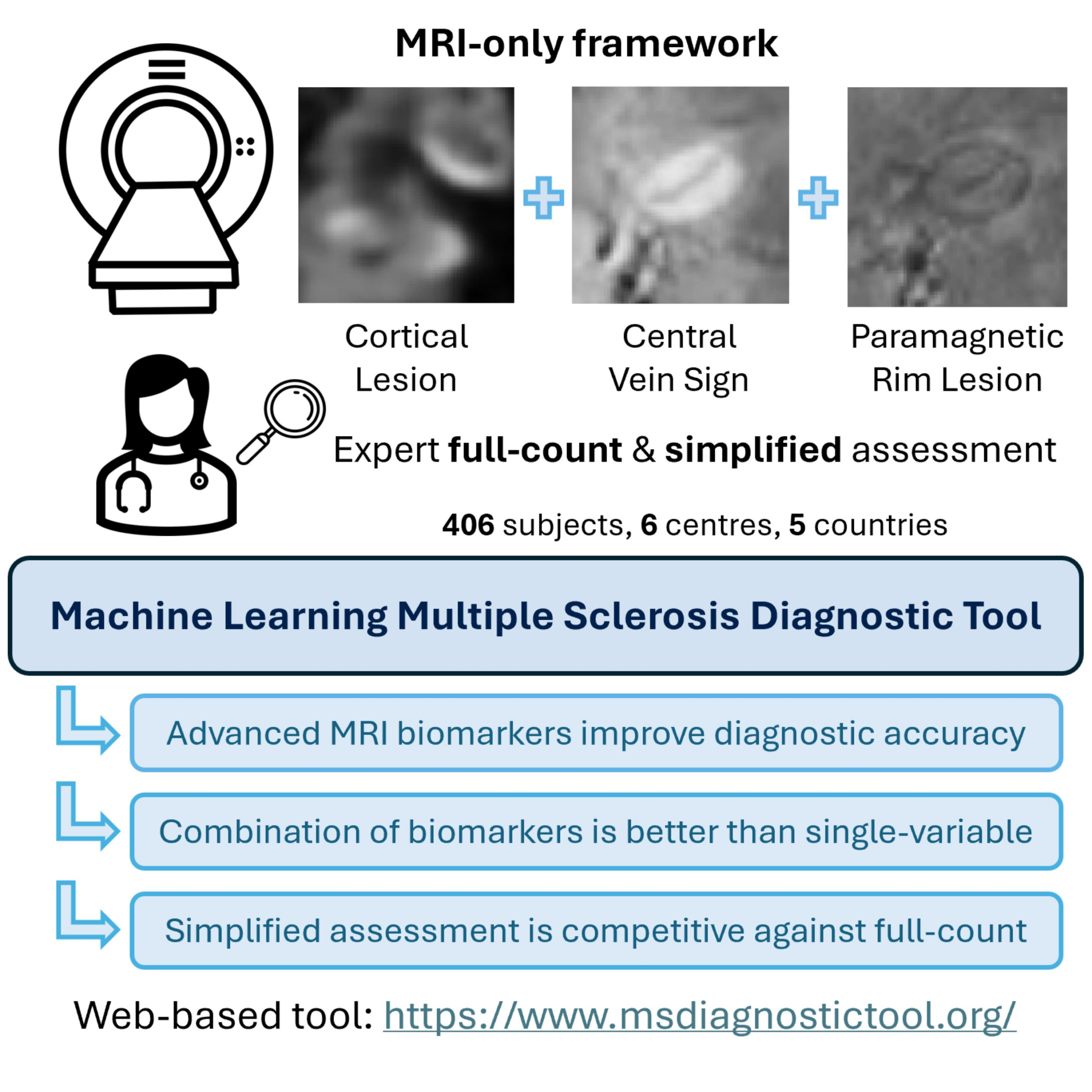
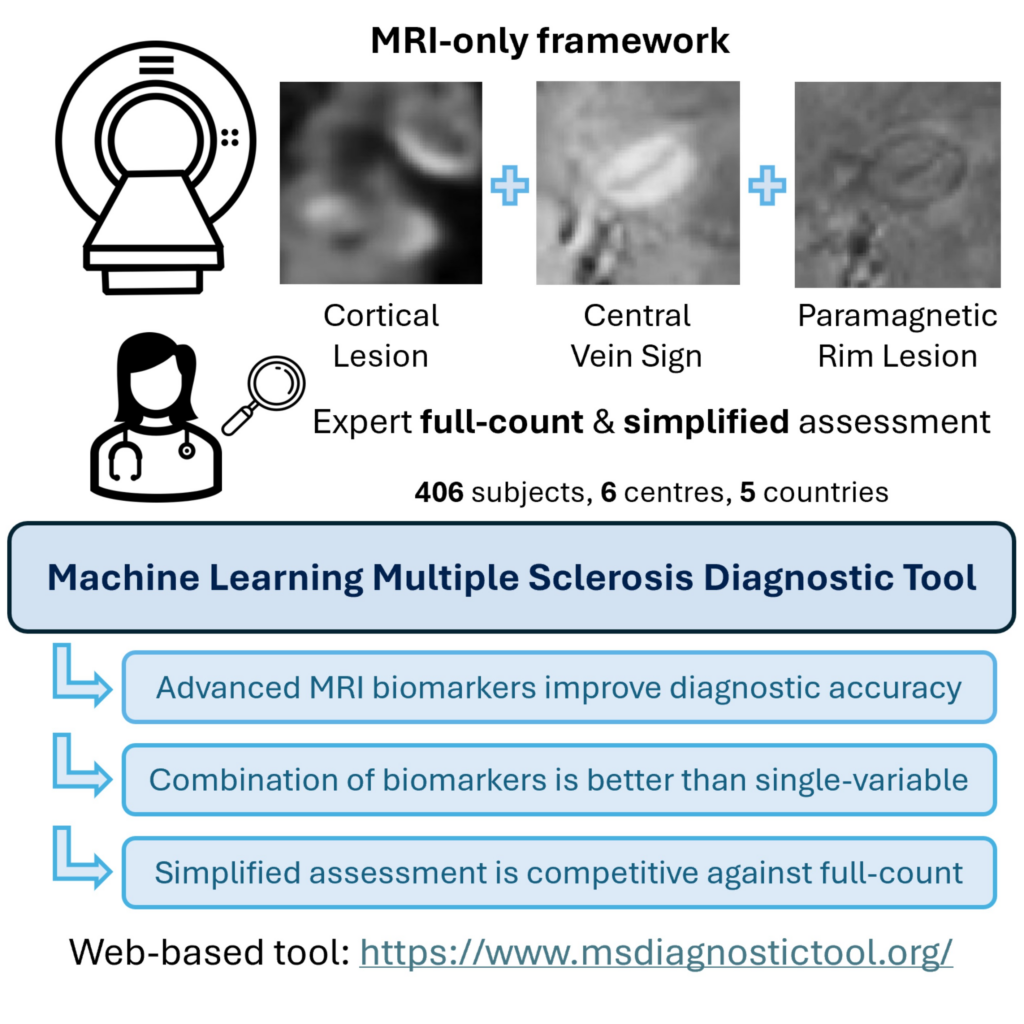
Multiple sclerosis diagnostic criteria lack optimal specificity, leading to potential misdiagnosis. Advanced magnetic resonance imaging (MRI) biomarkers like the central vein sign, cortical lesions, and paramagnetic rim lesions are highly specific to multiple sclerosis and could potentially improve diagnostic accuracy. In this study, we applied machine learning techniques to a retrospective, multicentric dataset of 322 multiple sclerosis/multiple sclerosis-mimic (204/118) and 84 prodromal multiple sclerosis/non-multiple sclerosis (43/41) adult patients, incorporating the central vein sign, cortical lesions, and paramagnetic rim lesions. We compared (5×2 cross-validation combined F-test) the diagnostic performance of 71 machine learning models, each corresponding to a distinct combination of full-count or simplified biomarker inputs, against the baseline dissemination in space McDonald criteria. The aim was to evaluate the multiple sclerosis diagnostic power of combining these biomarkers in an MRI-only diagnostic framework. 51 of the 71 models significantly outperformed the dissemination in space criterion (p < 0.05), with balanced accuracy improvements up to 13.0% (confidence interval: [+10.5; +17.0]). The best overall model (random forest, using full-count assessments) achieved 95.7% (confidence interval: [93.2; 99.7]) balanced accuracy; the best simplified model (logistic regression, using only simplified assessments) reached 94.7% with no significant difference with the former (p=0.29). Notably, 12/51 high-performing models used only simplified assessments. To further investigate the models’ generalisability, external validation on two out-of-distribution test sets using bootstrapping (1000 resamples) confirmed these results and highlighted a more robust generalisation for the best model using solely simplified biomarkers. On the first external test set (n=37, Verona), the simplified model achieved 97.2% balanced accuracy, while the full-count model reached 93.3% (vs. 83.3% for baseline). On the second test set (n=84, prodromal cases), the simplified model achieved 92.6% (vs. 60.1% for baseline) showing competitive performance against the full-count model (93.9%). Both models improved all key performance metrics—balanced accuracy, sensitivity, specificity, precision, and F1 score—over the baseline on both test sets (all p<0.0001). Within a non-invasive MRI-only diagnostic framework, these results show that the incorporation of advanced imaging biomarkers into the multiple sclerosis-MRI diagnostic criteria significantly enhances the diagnostic accuracy – a statement holding true even when using simplified central vein sign, cortical lesions, and paramagnetic rim lesions assessments. The study also provides a publicly available online diagnostic tool, facilitating further interaction, validation and clinical support (https://www.msdiagnostictool.org).

Similar Posts

  • | | |

    BIDS Managing and Analysis Tool

    > Github repository
    The BMAT software is a complete and easy-to-use local open-source neuroimaging analysis tool with a graphical user interface (GUI) that uses the BIDS format to organize and process brain MRI data for MS imaging research studies. BMAT provides the possibility to translate data from MRI scanners to the BIDS structure, create and manage BIDS datasets as well as develop and run automated processing pipelines.

    BMAT is now compatible to work with remote server using shared samba folder and a slurm scheduler to process data on remote server. It has to be noted that this feature has been implemented for users based in the Institute of NeuroSciences (IoNS) from UCLouvain. Therefore, it may not work easily with every servers, but feel free to fork the code and adapt it for your institue.

  • |

    Human in the Loop

    Le projet Human in the Loop vise à améliorer l’intégration de l’intelligence artificielle dans le domaine de la santé en optimisant la synergie entre l’humain et la machine. Il se déploie autour de deux axes complémentaires. Le premier, centré sur le patient, consiste à développer des outils basés sur l’IA capables de suivre l’évolution de…

  • |

    DIOC

    Ce projet vise à transformer la manière dont sont évalués et pris en charge les troubles psychiatriques, en particulier lestroubles liés à l’usage de substances et les troubles de l’humeur. L’objectif : développer un dispositif intégré d’évaluation multifactorielle capable d’orienter chaque patient vers les soins les plus adaptés dès l’hospitalisation, afin de prévenir les rechutes…

  • | | | | |

    FEDER – MedReSyst – AI4Alzheimer

    Ce projet a pour objectif de développer des marqueurs biologiques pour dépister la pathologie Alzheimer dans la population générale, en utilisant l’intelligence artificielle pour identifier des marqueurs sanguins prédictifs de cette maladie. Cet objectif s’articule avec ceux développés dans d’autres projets, entre autre :(1) Faciliter le transfert des données patients vers les bases de données…

  • | | | | | | | |

    Cardinal

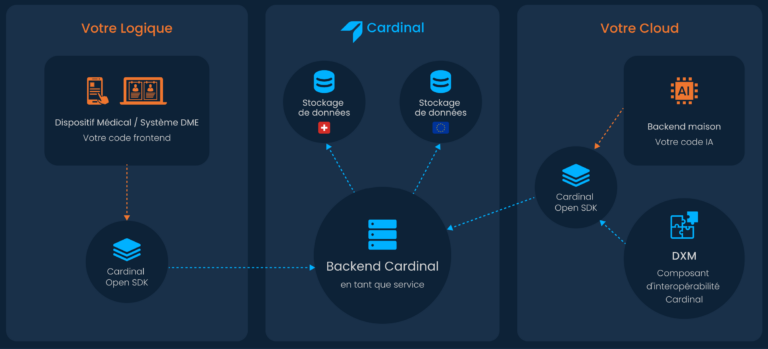
    Cardinal est le backend sécurisé de référence pour la Health-Tech. Que vous conceviez des dispositifs médicaux, des dossiers médicaux et patients (DMI-DPI), ou des applications patient-médecin, le Backend et les SDKs Cardinal offrent les outils et le support pour concrétiser votre vision, réduire vos coûts de développement et accélérer votre mise sur le marché. Chaque fonctionnalité disponible dans Cardinal se concentre sur…

  • |

    AI4Brain

    Click here to access the project’s website: Le projet IA for Brain vise à introduire des outils avancés d’analyse, de modélisation et de prédiction dans le suivi des patients atteints de troubles neurologiques ou psychiatriques. Il se concentre sur quatre axes : faciliter le transfert et l’harmonisation des données patients, définir les meilleurs modèles et…

Laisser un commentaire